The House of the Spirits, mapped
My book club is reading Isabel Allende’s The House of the Spirits, and about halfway through I lost the thread of who was related to whom. So I stopped trying to hold it in my head and drew it instead.
The confusion is deliberate. Allende braids three families together across four generations, then hands out the same few names over and over. There is a Pedro García, a Pedro Segundo García, and a Pedro Tercero García: first, second, third. There are two men named Esteban García, father and son, with nothing in the text to tell them apart. Clara’s mother is Nívea, her daughter is Blanca, her granddaughter is Alba, and all three names mean white.
So here is the whole cast on one chart.
Spoilers ahead. The map runs to the last page. If your club is still early in the book, bookmark this and come back.
The family, and who loved whom
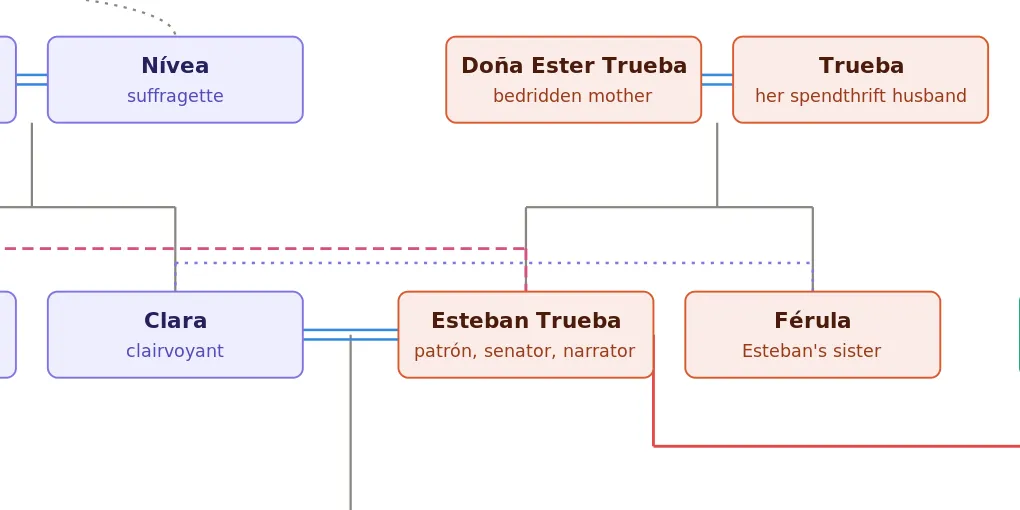
Scroll the panel sideways for the García side.
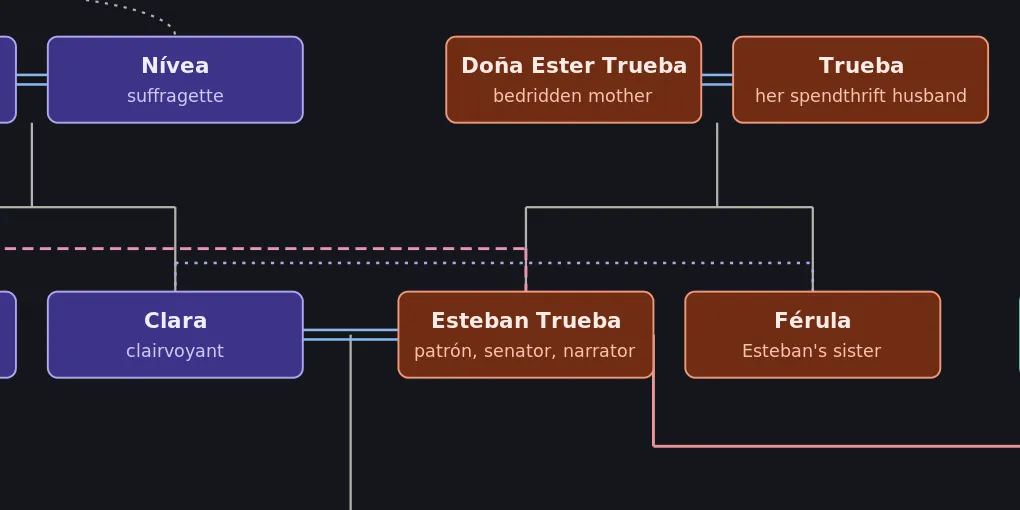
Three families: the spiritualist del Valles in purple, the landowning Truebas in coral, the García peasants of Tres Marías in teal. Esteban Trueba is the hinge that joins all three. He marries into the del Valles. His daughter spends her life loving a García. And his rape of Pancha García starts a line that comes back, two generations later, for his granddaughter. Both red lines on the chart run through him.
Two men, one name
The study guides I checked treat Esteban García as a single character, and it’s an easy mistake. He isn’t. Pancha names her son Esteban, after the man who raped her. That son names his own son Esteban too. The novel gives them no middle name, no numeral, no nickname.
The second one is the character who matters: the boy who sells Pedro Tercero’s hiding place for a reward and watches the patrón take his fingers, who kisses the child Alba in the garden, and who thirty years later arrests and tortures her. Trueba’s bastard grandson. The name is the only thing he ever inherited, and he spends the book collecting the rest.
Everyone else
Course Hero’s index runs to eighty-one entries, and most of them appear exactly once: a woodcutter, a cook, a boy in an empty lot. They aren’t on the tree because they have no blood or love tie to it, but they’re handy to have listed when someone asks who the guy with the ants was.
The big house on the corner
- NanaLifelong del Valle servant; follows the family to the big house and dies of fright in the earthquake.
- Dr. CuevasFamily doctor; performs Rosa's autopsy and later delivers Clara's children.
- Father RestrepoPriest who denounces Clara from the pulpit as possessed by the devil.
- HonorioGardener whose dream Clara reads; he wins 80 pesos and makes her reputation.
- Miss AgathaEnglish governess hired for Clara; defeated by the heat, the food and the clairvoyance.
- Swiss tutorAnother tutor for Clara, gone as quickly as the rest.
- French tutorYoung tutor made pregnant by Luis; Severo forces the marriage, which turns out happy.
- RostipovRumanian mystic consulted about Clara's silence; she can speak, she just won't.
- Don Salomón ValdesClara's godfather; hangs himself believing he is ruined, as Clara foresaw.
- Getulio ArmandoSwindles Severo out of half his fortune, exactly as Clara warned.
- Big CuckoldMechanic who cannot fix the brakes of the family Sunbeam, Covadonga.
- Big Cuckold's wifeLeaves him and ties rams' horns to his fence, earning him the name.
- DriverRetrieves Nívea's severed head from under the bushes, vomiting as he does it.
- AssistantYoung man at Rosa's autopsy who kisses her body and handles her like a bride.
- CaretakerCemetery keeper Esteban bullies and bribes on the night of Rosa's funeral.
- ServantDoña Ester Trueba's attendant, who stays with her to the end.
- Old womanNeighbour in Férula's tenement who confirms she has not been seen for days.
- Zorebabel Blanco JamasmiéLocal mayor who walks in on Férula in the bathroom and shakes her hand.
- King of the Pressure CookersRich suitor of Blanca's; Esteban cannot stand him.
- Luisa MoraLast of the three Mora sisters, Clara's spiritualist circle; warns Esteban and Alba of the coup.
The del Valle relatives
- Uncle JuanNívea's brother, never heard from again after breaking wind before a beauty queen.
- Uncle MateoNívea's brother, cursed in Brazil until an amulet restores his hair, nails and teeth.
- Cousin AntonietaMarcos serenades her with a barrel organ; she marries an elderly diplomat instead.
- JerónimoBlind del Valle cousin who climbs highest in the yard tree and dies of the fall.
- LongfellowEnglish captain of the ship on which Uncle Marcos dies.
Tres Marías
- WoodcutterCarts Esteban out to the ruined estate when nobody else in San Lucas will.
- Mr. BrownHired against the ant plague; old Pedro García solves it instead.
- Father José Dulce MaríaSocialist priest who turns Pedro Tercero's poems into songs and hides him in a cassock.
- Sánchez brothersLocal strongmen who beat and kill socialists who come to preach.
- Socialist leaderEarly organiser beaten to death by the Sánchez brothers and displayed as a warning.
- SofíaRuns the Red Lantern, the brothel near Tres Marías.
- CarmeloThe Red Lantern's homosexual member.
- MatronMadam with a fake French accent who brings Esteban 'the best in the house' — Tránsito.
The count's house in the north
- Indian servantThe count's silent favourite, hostile to Blanca and part of his photographic sessions.
- CookEnormously fat, quietly spiteful to Blanca, and among the naked subjects of the photographs.
The country, the coup, the dictatorship
- The CandidateThe socialist candidate, unnamed; a Salvador Allende figure.
- The PresidentThe same man once elected — reforming, then killed in the coup.
- The DictatorThe general who takes power; a Pinochet figure.
- The PoetNeruda figure, a guest at the big house who held Alba on his lap; his funeral ends the country's freedom.
- General HurtadoHead of the military; sends for Esteban's stockpiled weapons, half of which Alba has buried.
- The NuncioThe papal ambassador who gets Blanca and Pedro Tercero safely out of the country.
- OfficerReceives Esteban rudely at the new government's headquarters and confiscates his car.
- LieutenantDrives him home afterwards, dismayed at how things have turned out.
- Pale soldierHelps the captured Jaime, whose clinic saved his mother; brings Esteban the news of his death.
The university and the resistance
- Sebastián GómezCrippled, tireless professor who marches with the students and calls Alba 'Countess'.
- Ana DíazAlba's fellow militant and cellmate, who keeps her alive with her courage.
- AndrésYoung socialist, Ana's boyfriend, jailed alongside them.
Prison, and the way out
- Man in chargeLeads the raid on the big house and takes Alba away.
- AdrianaPrisoner in the women's camp who has lost her mind; the others raise her children.
- Fine-featured doctorCruel but competent; treats Alba's infected hand at a secret clinic.
- RojasMale nurse who nurses Alba back and tells her Amanda is dead.
- Candy manOne of the silent men in the van out of the camp; gives her a sweet and a kind word.
- BoyFinds Alba dumped in an empty lot and leads her to shelter.
- Short, dark womanThe boy's mother; feeds Alba and finds her a carriage home at real risk to herself.
- Tránsito SotoThe prostitute Esteban lent fifty pesos at the Red Lantern; now owner of the Christopher Columbus, she is the one who gets Alba out.
- LadyUniformed receptionist at the Christopher Columbus who tries to keep Esteban from her.
- MustafáThe giant Tránsito puts in charge once the hotel becomes a cooperative.
- Friend 1Old friend at the brothel late in Esteban's life, who chooses a young man.
- Friend 2The other, who chooses a woman dressed as a slave.
What I noticed drawing it
Everything in the first generation comes back in the fourth, turned around. Esteban’s rape of Pancha returns as Esteban García’s rape of Alba. The fifty pesos he once lent a prostitute at the Red Lantern return as the favor that gets Alba out of prison alive. The dog Uncle Marcos drags home in chapter one is still there in the last pages, in a moth-eaten sort of way.
Alba, writing the book, is the first person in four generations who is handed the chain and decides not to pass it on. That’s the whole novel, really. The chart is just the long way of saying it.